By Joshua J. Horowitz · October 2026
On October 1, 2026, Judge Sara E. Hill of the Northern District of Oklahoma granted a motion to suppress in United States v. Kyle, No. 26-CR-00189-SEH, holding that a sheriff’s deputy’s warrantless query of automated license plate reader (“ALPR”) systems, including Flock, was a search under the Fourth Amendment. Judge Hill recognized the threat to our constitutional liberties from ongoing, and increasing, mass surveillance. It is an important decision, and it gives defense lawyers nationwide a powerful basis to challenge warrantless ALPR queries, which appear in more and more of our cases as Flock and similar systems spread.
What happened
A Tulsa County deputy parked along the highway saw a Mazda with a California license plate. According to the Court, he began following the car “for no apparent reason other than the fact that it had a California license plate,” and ran the plate through the ALPR systems available to him. Slip op. at 2–3. The query gave him “an entire month’s worth of location data tied to the license plate on Kyle’s car, including more than fifty sightings across multiple states.” Id. at 34.
The deputy then stopped the car for following another vehicle too closely, issued a warning, and, after the driver declined consent to a search, detained her for a dog sniff that led to her arrest. The Court suppressed the evidence on two independent grounds: the deputy unlawfully extended the traffic stop without reasonable suspicion, and the ALPR query itself was an unconstitutional warrantless search. It is the second holding that sets this decision apart.
What a license plate reader search actually returns
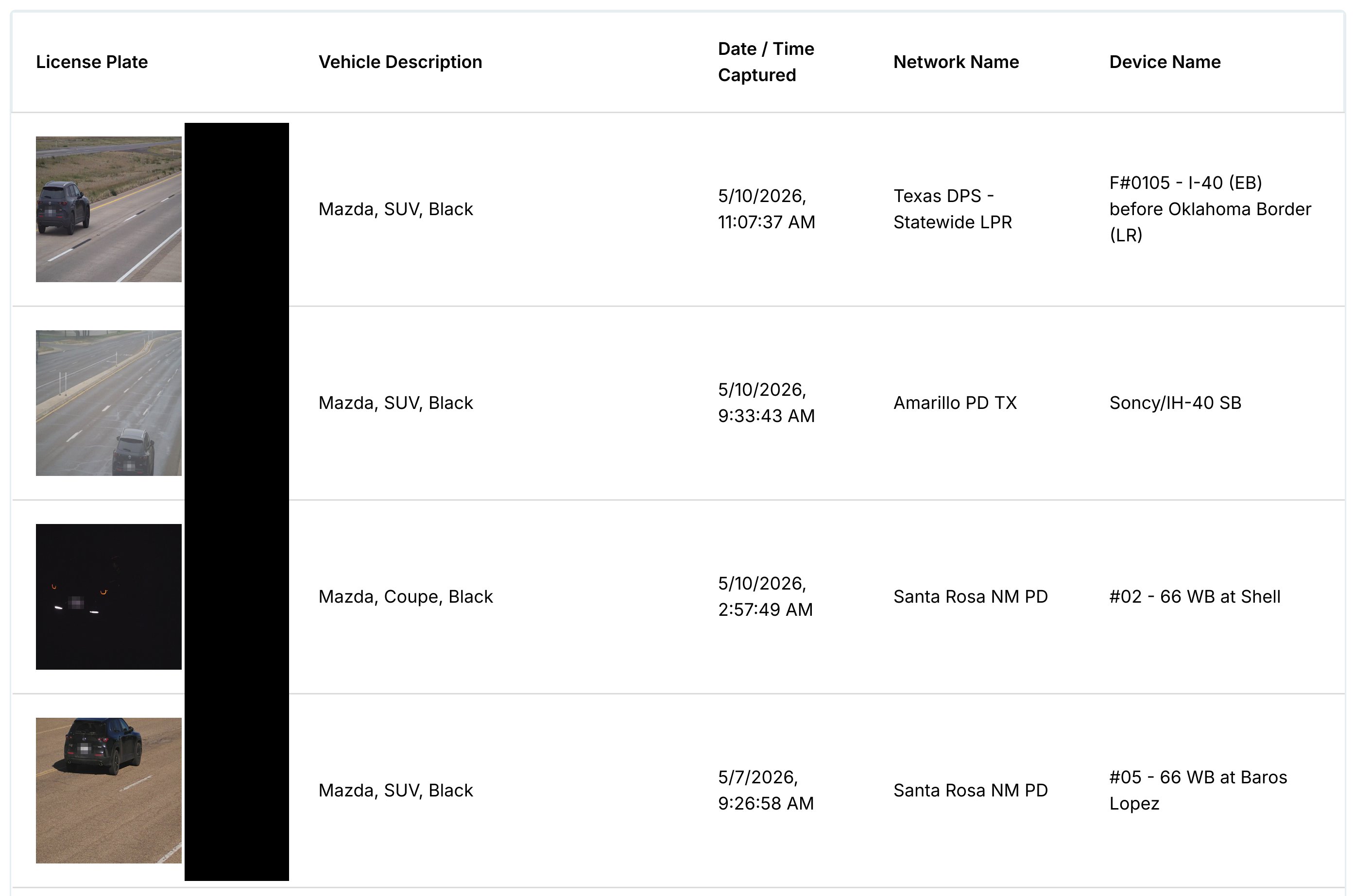
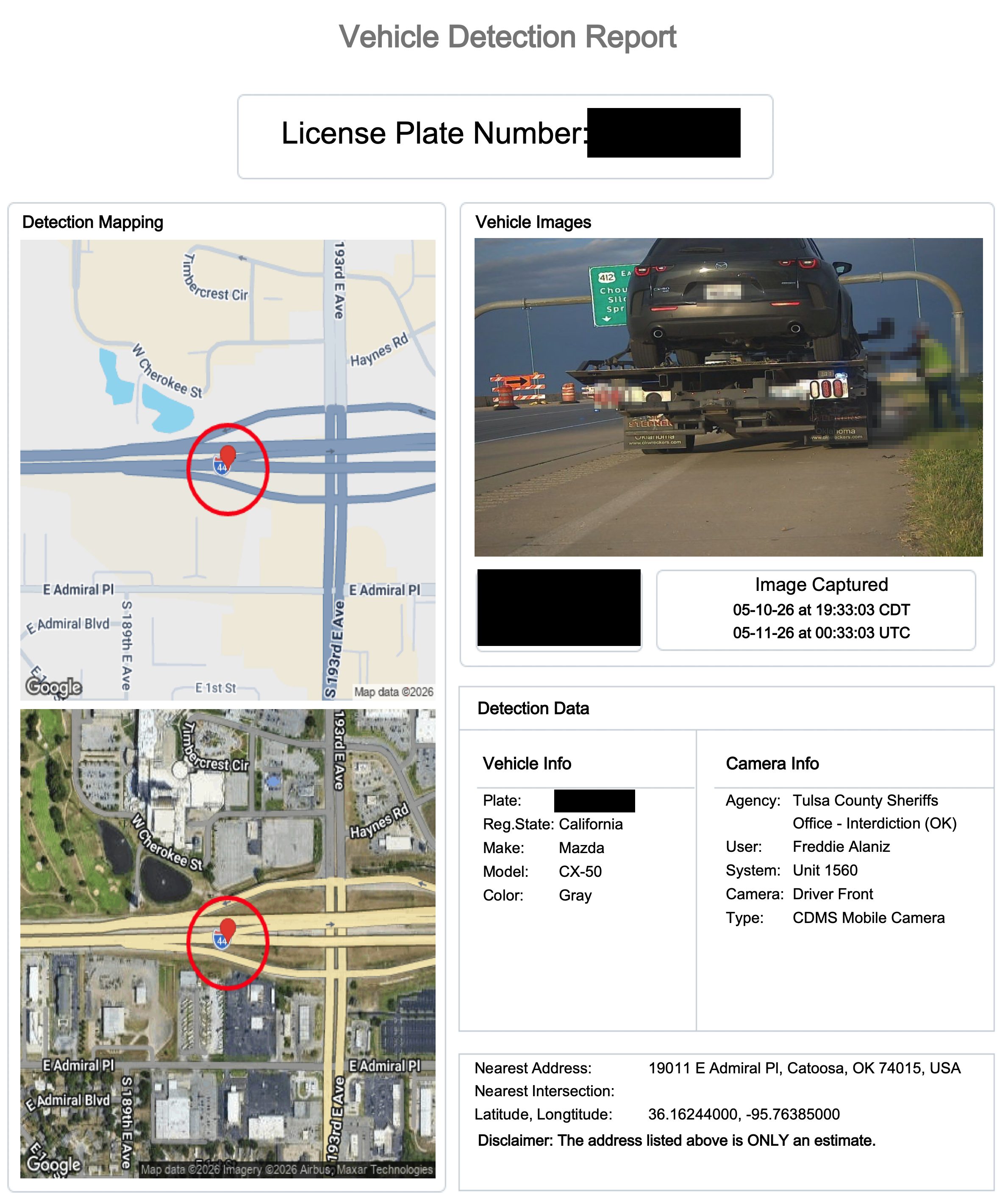
From a practice standpoint, it helps to see what the officer saw. A Flock query returns photographs of the queried license plate at every location where a camera in the network captured it, along with the date and time, the network that owns the camera, and the camera’s location. Motorola Solutions offers a separate system, Vigilant VehicleManager, that does essentially the same thing with its own network of fixed and patrol-car cameras. The two systems started from different places. Flock sells inexpensive cameras to cities, neighborhoods, and businesses; Motorola built its network from police-car and fixed law enforcement cameras. But they increasingly deliver the same thing to law enforcement: a searchable history of where a vehicle has been. Both outputs were publicly filed, not under seal, as exhibits to the motion to suppress in Kyle (ECF Nos. 47-3 and 47-4, filed Aug. 3, 2026).
The Flock printout shows a search across all networks over a four-week window, returning more than fifty sightings that span nine states, from Arizona to Georgia. The cameras belonged to city police departments, sheriff’s offices, a state police agency, two drug task forces, and even a Lowe’s store. The output also illustrates a reliability point that matters in litigation: the same plate is described in different entries as a Mazda SUV, a coupe, a Toyota sedan, a Hyundai, and a Land Rover, in black, blue, and silver.
The VehicleManager report adds roughly two dozen detections from state police cameras along Interstate 40, camera trailers, and the deputies’ own patrol-car cameras, which logged the car repeatedly as they followed and stopped it, and photographed it on a tow truck afterward. And, as an email from the prosecutor filed with the motion confirms, the only search terms the deputy entered were the plate number and state, with the stated reason entered as “traffic violation” in Flock and “investigation” in VehicleManager. ECF No. 47-2; see slip op. at 3.
More than a glance at a license plate
As Judge Hill acknowledged, nearly every court to consider the question has held that ALPR use is not a search, because people have no reasonable expectation of privacy in their movements on public roads. Those decisions rely heavily on United States v. Knotts, 460 U.S. 276 (1983), in which the Supreme Court approved the use of a simple radio “beeper” to follow a car. In Knotts, the Court responded to the concern about round-the-clock surveillance by saying that if “dragnet type law enforcement practices” ever came to pass, “there will be time enough then to determine whether different constitutional principles may be applicable.” 460 U.S. at 283–84 (quoted in slip op. at 31).
Judge Hill concluded that the time has come: “this Court is now faced with technology that appears to be approaching the dragnet type law enforcement practice Mr. Knotts warned of.” Slip op. at 31.
The Court likened the ALPR network to the location tracking the Supreme Court addressed in Carpenter v. United States (2018) and, this year, in Chatrie v. United States, where the Supreme Court held that obtaining a phone’s location history is a Fourth Amendment search. The principle the Court drew from those cases is that people “have a reasonable expectation of privacy in the whole of their physical movements.” Id. at 33–34 (quoting Chatrie and Carpenter). And the Court described the ALPR network itself this way:
“This is a type of indiscriminate mass surveillance. It is not targeted on a single individual, as in Carpenter. It is a tool that collects information about all vehicles that pass by any network-connected camera at all times, and it serves up the information to law enforcement on demand.” Slip op. at 34.
The Court was troubled by the scale of that surveillance, and Judge Hill illustrated the intrusion on our expectation of privacy in terms that are simple, yet powerful:
“Think about it this way. We might reasonably expect our friends and family to tell us something like: ‘Hey, I saw you out driving by the store last week.’ But we do not expect people we know—let alone strangers, and especially not law enforcement—to randomly approach us to say: ‘Hey, I have been following your car for the last 30 days, and here is a detailed log of every place your vehicle has been with supporting photographic evidence. I am also going to share this information with law enforcement throughout the country so they know your whereabouts, too.’” Slip op. at 34–35.
Where unchecked surveillance leads
Some of the most important passages in the opinion look ahead. Judge Hill noted that the deputy’s own patrol car cameras fed the system, and that it “is not difficult to imagine what is next: more cameras on more street signs, buildings, and perhaps on more police cars. It is also no longer difficult to imagine law enforcement using a fleet of drones hovering over an entire city so they don’t miss the movement of a single vehicle.” As the Court put it, “This is not hypothetical catastrophizing.” Slip op. at 35.
For that, the Court relied on Kyllo v. United States, 533 U.S. 27, 36 (2001), for the proposition that courts “must take account of more sophisticated systems that are already in use or in development,” a principle the Supreme Court carried forward in Carpenter and Chatrie. Slip op. at 35–36. And the Court spelled out what this kind of data can reveal: a log that “could track and log a couple struggling to start a family at the fertility clinic,” or show “which doctor someone goes to or what lawyer’s office someone visits.” Id. at 36.
Judge Hill’s conclusion is hard to improve on: “why is it the government’s business where everyone goes all the time?” and “It is not too much to draw the line at indiscriminate mass surveillance.” Id. at 37.
Not every court agrees
By contrast, three weeks earlier, the Central District of California reached the opposite result in United States v. Riley, No. 2:25-cr-00380-VAP, ECF No. 181 (C.D. Cal. Sept. 10, 2026). Detectives investigating two kidnappings and robberies queried a Culver City Flock database and a Motorola ALPR database in Carson, retrieving four photographs of the suspect vehicle in each investigation. Senior Judge Virginia A. Phillips held that the queries were not searches.
The Riley court found that the license plate readers at issue did not implicate Carpenter and Chatrie, and took a very different view from the Kyle Court, finding that “there is no evidence indicating that the Flock and Motorola databases provided law enforcement with an extensive, detailed log of a person’s movements.” Riley, slip op. at 6. The Riley court focused on the limited number of photographs retrieved, even though, by its own account, the Culver City database alone holds approximately 18 million photographs a month (including duplicates and blurry images). Id. at 3.
To be sure, the facts in Riley were different: detectives ran targeted queries in kidnapping and robbery investigations, starting from license plate information the victims themselves provided, while the deputy in Kyle pulled a month of a driver’s travel history because of an out-of-state license plate. But Riley misses the point—the privacy intrusion is not limited to the handful of images a particular query returns. It is the system itself: a network that records every vehicle that passes its cameras and makes that history available to law enforcement on demand.
Discovery in license plate reader cases
Both decisions turned on the record: what was searched, why, over what period, and what came back. That makes discovery critical. In a case involving an ALPR search, defense counsel should consider requesting:
- As much statistical information as possible about the density of Flock and other ALPR surveillance in the jurisdiction: the number and locations of cameras, and the networks and agencies that share data.
- The reasons for each query, as entered by law enforcement.
- Audit logs showing how frequently the database was accessed during the investigation, to establish the depth of the surveillance. Motorola’s own VehicleManager brochure states, at page 8, that “every keystroke and user action is recorded, with additional usage justification requirements for certain functionality, so that detailed audits can be conducted.”
- The complete output of each query, and how many hits the database holds for the particular license plate.
- The search parameters (the date range and the networks searched) and the data retention policies for each system.
Where do we go from here?
In Kyle, the government has 30 days from the date of the decision to appeal. As of this writing, no notice of appeal appears on the docket.
There is clearly a difference of opinion between courts in California and Oklahoma on this issue, which could eventually set up a showdown between the Ninth and Tenth Circuits. Other circuits are likely to weigh in as well, given how pervasive the issue has become. Practically, for lawyers across the country, this is a developing issue that is not going away as mass surveillance continues to infiltrate our lives at a rapid pace.
The Federal Public Defender’s motion to suppress in Kyle is worth reading for anyone litigating these issues.
This article is for general information and is not legal advice. Reading it does not create an attorney-client relationship. Citations to “slip op.” are to the Kyle opinion unless otherwise noted. Quotations are from the opinions in United States v. Kyle, No. 26-CR-00189-SEH (N.D. Okla. Oct. 1, 2026), ECF No. 62 (motion to suppress, ECF No. 47), and United States v. Riley, No. 2:25-cr-00380-VAP (C.D. Cal. Sept. 10, 2026), ECF No. 181. The motion and exhibits discussed in this article were publicly filed on the court’s docket and are not under seal; license plate information and a bystander have been redacted from the images reproduced here.